How to Get Rid of a Headache Fast: 12 Methods That Actually Work

You've got a headache right now, and you want it gone. Fair enough.
But here's the thing most headache relief articles won't tell you: the method that works depends on the type of headache you're dealing with. A cold compress that kills a migraine might do nothing for a tension headache. The neck stretch that saves your afternoon won't touch a dehydration headache.
So instead of giving you a random list and wishing you luck, I'm going to match each method to what it actually works best for. Try the ones that fit your symptoms first.
The 60-Second Check: What Type of Headache Do You Have?
Before you try anything, spend a minute figuring out what you're dealing with:
- Throbbing, one-sided, worse with movement? Likely a migraine. Skip to methods 1, 2, 5, and 10.
- Tight band around your head, both sides? Tension headache. Try methods 3, 4, 6, and 7.
- Face pressure, congestion, worse when bending forward? Sinus headache. Go to methods 8 and 11.
- Not sure / general headache? Start with methods 1 and 2 — they work across the board.
1. Hydrate — But Do It Right
Best for: All headache types, especially dull/throbbing pain
This is the first thing to try because it's the most underrated headache cause. A study from the European Journal of Neurology found that drinking water reduced headache intensity within 30 minutes for most participants who were even mildly dehydrated.
But "drink water" is incomplete advice. Here's how to do it effectively:
- Drink 500ml (about 16 oz) right away — small sips over an hour won't cut it if you're already dehydrated
- Add a pinch of salt or drink an electrolyte mix if you've been sweating, exercising, or had alcohol
- Don't chug ice water — room temperature absorbs faster
Speed: You should feel relief within 20-30 minutes if dehydration was the cause.
2. Cold Compress on Your Forehead and Temples
Best for: Migraines, throbbing headaches, headaches with heat/flushing
Cold therapy works by constricting blood vessels and reducing inflammation — exactly what you need when a migraine is dilating the vessels around your brain. A 2013 study in Hawaii Journal of Medicine & Public Health found that applying a frozen neck wrap at the carotid arteries significantly reduced migraine pain.
How to do it properly:
- Wrap ice or a cold pack in a thin cloth (never directly on skin)
- Place on your forehead, temples, or the back of your neck
- Keep it on for 15-20 minutes, then off for 10
- For migraines specifically, try the back of the neck — that's where the carotid arteries are closest to the surface
Speed: Most people notice relief within 10-15 minutes.
3. Heat Therapy for Tension Headaches
Best for: Tension headaches, neck-related headaches, stress headaches
If cold is for migraines, heat is for tension. Warm compresses increase blood flow to tight muscles and help them relax. This is especially effective if your headache started in your neck or shoulders and crept upward.
How to do it:
- Use a warm (not hot) towel, heating pad, or microwaveable rice bag
- Place on the back of your neck and shoulders for 15-20 minutes
- A warm shower aimed at the base of your skull works too
- Alternate with gentle neck stretches between heat applications
Pro tip: If you're not sure whether your headache is a migraine or tension type, try cold first. If it doesn't help within 15 minutes, switch to heat. Your response tells you a lot about what's going on.
4. The 4-Minute Neck and Shoulder Release
Best for: Tension headaches, desk-work headaches, headaches that start in the neck
Most tension headaches originate from tight muscles in the neck, shoulders, and jaw. You can't always get a massage, but you can do this routine anywhere:
Minute 1 — Neck tilts: Drop your right ear toward your right shoulder. Hold 15 seconds. Repeat left side. Do each side twice.
Minute 2 — Chin tucks: Pull your chin straight back (like you're making a double chin). Hold 5 seconds. Repeat 8 times. This releases the suboccipital muscles at the base of your skull — a major headache culprit.
Minute 3 — Shoulder shrugs: Raise your shoulders to your ears, squeeze hard for 5 seconds, then drop them completely. Repeat 6 times. The release phase is where the magic happens.
Minute 4 — Jaw release: Open your mouth wide. Place two fingers on your jaw joint (right in front of your ears). Massage in small circles for 30 seconds. Then let your jaw hang open and relaxed for 30 seconds.
Speed: Often provides noticeable relief within 5-10 minutes of completing the routine.
5. Darken the Room and Reduce Stimulation
Best for: Migraines, headaches with light/sound sensitivity
This isn't just "resting" — it's removing the stimuli that are actively making your headache worse. Photophobia (light sensitivity) affects up to 80% of migraine sufferers according to the American Migraine Foundation, and bright light can intensify pain even in non-migraine headaches.
The full protocol:
- Close blinds and turn off overhead lights
- Put your phone face-down (the blue light is especially problematic)
- If you can't darken the room, wear sunglasses — it looks ridiculous indoors but it works
- Reduce noise: earplugs, noise-cancelling headphones, or a white noise machine
- Lie down if you can, slightly elevated
Even 15-20 minutes in a dark, quiet environment can break the pain cycle.
6. Pressure Points That Actually Have Evidence
Best for: Tension headaches, general headaches, stress-related headaches
Acupressure for headaches sounds like wellness fluff, but there's real research behind specific pressure points. A study published in The American Journal of Chinese Medicine found that acupressure reduced chronic headache intensity in participants who used it consistently.
The three points worth trying:
LI-4 (Union Valley): The fleshy area between your thumb and index finger. Press firmly with your opposite thumb and hold for 2 minutes per hand. This is the most-studied pressure point for headache relief. Note: avoid during pregnancy.
GB-20 (Wind Pool): The two hollows at the base of your skull, where your neck muscles attach. Press both points simultaneously with your thumbs, angling upward. Hold for 30 seconds, release, repeat 4-5 times.
TE-3 (Zhongzhu): The groove between your fourth and fifth knuckles on the back of your hand. Press firmly for 1-2 minutes per hand.
Speed: Usually takes 5-10 minutes to feel a change. Works best when combined with slow, deep breathing.
7. Caffeine — The Double-Edged Sword
Best for: Headaches where caffeine withdrawal is the cause, migraine (as an adjunct)
Caffeine is genuinely useful for headaches — that's why it's an ingredient in Excedrin. It constricts blood vessels and boosts the effectiveness of pain relievers by up to 40% according to the Cleveland Clinic.
But here's where people go wrong: caffeine is only helpful if you're not already a heavy daily consumer. If you drink 3+ cups of coffee a day and skip your morning cup, that headache isn't a mystery — it's withdrawal.
How to use caffeine strategically:
- If you haven't had caffeine today and it's past your usual time: drink a cup of coffee or strong tea. Your headache is probably withdrawal.
- If you rarely drink caffeine: a small amount (50-100mg, roughly one cup of coffee) can genuinely help a headache.
- If you already had your normal caffeine: don't add more. More caffeine won't help and might make it worse.
Curious about the caffeine-headache relationship? We'll be publishing a deep dive on caffeine and headaches soon — including how to find your personal threshold.
8. Steam and Sinus Flush
Best for: Sinus headaches, congestion-related headaches, allergy headaches
If your headache comes with a stuffy nose and facial pressure, the pain is likely from inflamed, swollen sinuses. Steam opens them up and a saline rinse flushes out the irritants.
Steam method:
- Boil water, pour into a bowl
- Drape a towel over your head and the bowl
- Breathe deeply through your nose for 5-10 minutes
- Adding a drop of eucalyptus or peppermint oil can help (optional, but the menthol does open airways)
Saline rinse:
- Use a neti pot or squeeze bottle with a pre-made saline packet
- Always use distilled or previously boiled water — never tap water directly
- Rinse each nostril for 15-20 seconds
Speed: Relief often comes within 10-15 minutes as sinus pressure drops.
9. Peppermint Oil on Your Temples
Best for: Tension headaches, mild to moderate headaches
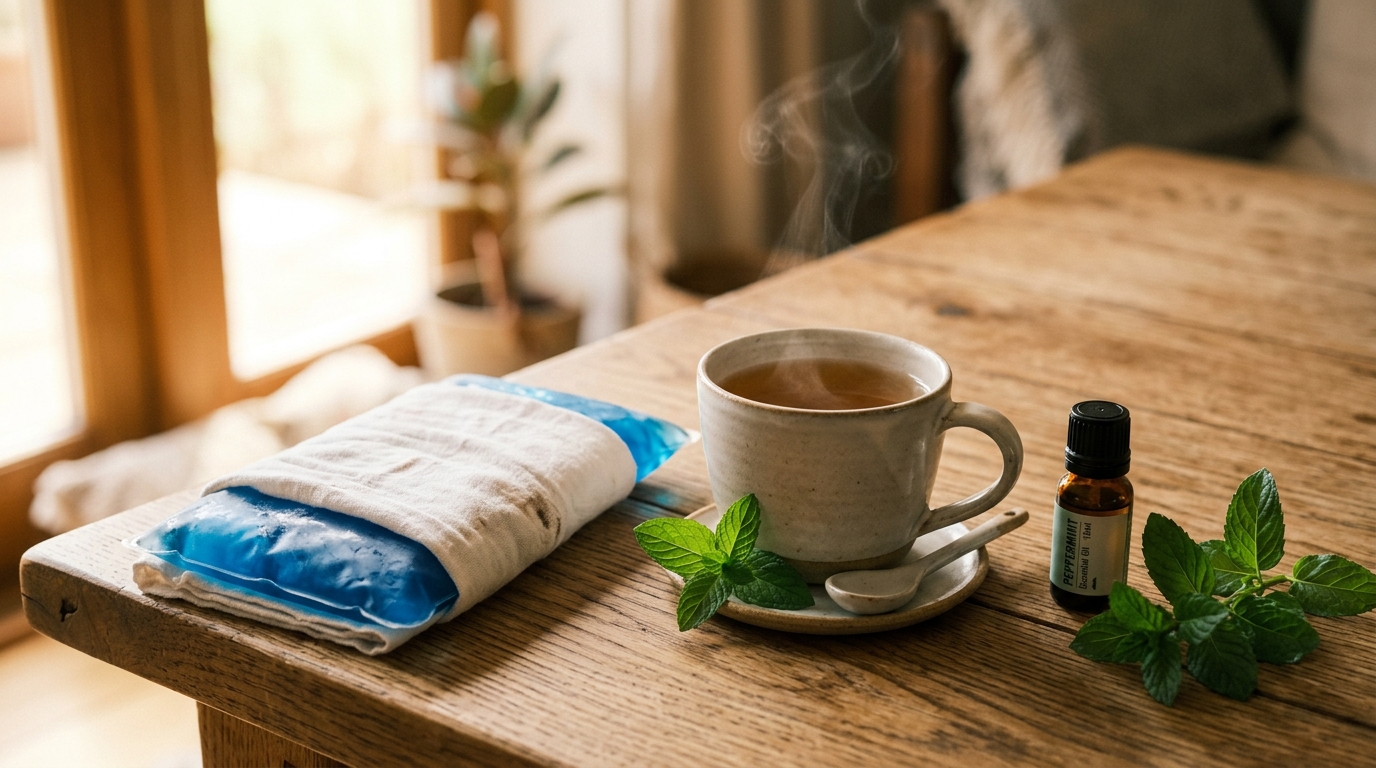
This one surprised me when I first looked at the research. A study published in Cephalalgia (the leading headache research journal) found that topical peppermint oil was as effective as 1,000mg of acetaminophen (Tylenol) for tension headaches.
The active ingredient is menthol, which creates a cooling sensation and relaxes the muscles under the skin.
How to use it:
- Dilute peppermint essential oil with a carrier oil (coconut, almond) — roughly 2-3 drops peppermint per teaspoon of carrier
- Apply to your temples, forehead, and the back of your neck
- Avoid your eyes (menthol and eyes do not mix)
- Reapply every 30 minutes if needed
If you don't have peppermint oil, products like Tiger Balm or Vicks VapoRub contain menthol and can provide a similar effect.
10. Controlled Breathing for Pain Modulation
Best for: All headache types, especially stress-triggered headaches
Deep breathing isn't just a relaxation technique — it directly affects your autonomic nervous system. Slow breathing activates your parasympathetic nervous system (the "rest and digest" mode), which reduces muscle tension, lowers heart rate, and can interrupt the pain signaling loop.
The 4-7-8 method works well for headaches:
- Breathe in through your nose for 4 seconds
- Hold for 7 seconds
- Exhale slowly through your mouth for 8 seconds
- Repeat for 4-6 cycles
Box breathing is another option if you find the 4-7-8 pattern difficult:
- Breathe in for 4 seconds
- Hold for 4 seconds
- Breathe out for 4 seconds
- Hold for 4 seconds
- Repeat for 5 minutes
Speed: Most people notice their headache start to soften after 3-4 minutes. It won't eliminate a severe migraine, but it measurably takes the edge off.
11. Elevate and Reposition
Best for: Sinus headaches, morning headaches, headaches that worsen lying flat
Gravity matters more than you'd think. Lying flat allows blood to pool in your head and sinus pressure to build. Simply changing your position can provide quick relief.
What to try:
- If lying down: prop yourself up with pillows to a 30-degree angle
- If sitting at a desk: stand up and walk around for 5 minutes
- If hunched over your phone: put it down and look straight ahead, rolling your shoulders back
This is especially relevant for people who get morning headaches — sleeping slightly elevated with a wedge pillow can prevent them altogether.
12. OTC Medication — When and How to Use It Wisely
Best for: Moderate to severe headaches that aren't responding to other methods
Sometimes you need medication, and there's no shame in that. But the type and timing matter.
Ibuprofen (Advil, Motrin): Best for headaches with inflammation — migraines, sinus headaches. Take with food. 200-400mg dose.
Acetaminophen (Tylenol): Good for tension headaches. Easier on the stomach. 500-1000mg dose.
Aspirin: Works well for migraines and tension headaches. The evidence for 900-1000mg aspirin for acute migraines is actually quite strong.
Excedrin (acetaminophen + aspirin + caffeine): The caffeine combo makes each ingredient more effective. Good for migraines if you don't have a prescription triptan.
The critical rule: Don't use any OTC headache medication more than 10-15 days per month. Beyond that, you risk medication overuse headache — where the pills themselves start causing daily headaches. If you're reaching for painkillers that often, it's time to talk to your doctor about preventive options.
Timing matters: Take medication at the first sign of a headache. Waiting until the pain is a 7/10 means the medication has to work much harder. Early intervention is always more effective.
Building Your Personal Headache Relief Playbook
Here's the real secret to getting rid of headaches fast: knowing what works for YOUR headaches specifically.
Different people respond to different methods. Maybe cold compresses do nothing for you but peppermint oil works every time. Maybe hydration alone solves 80% of your headaches. You won't know until you track it.
Keep a simple log for the next month:
- What type of headache you had
- What you tried
- How quickly it helped (or didn't)
- What else was going on (stress, sleep, food, weather)
After a few weeks, you'll have your own personal relief protocol — the 2-3 methods that reliably work for you, in the right order.
This is exactly what Claru helps you build. Log your headache, record what relief methods you tried, and the app learns your patterns over time. Instead of guessing every time your head starts pounding, you'll know exactly what to reach for first.
Track your headaches and what works with Claru — free download
Quick Reference: Methods by Headache Type
| Method | Migraine | Tension | Sinus | Dehydration | |---|---|---|---|---| | Hydrate | Yes | Yes | Yes | Best | | Cold compress | Best | Maybe | No | No | | Heat therapy | No | Best | Maybe | No | | Neck release | Maybe | Best | No | No | | Dark room | Best | Maybe | No | No | | Pressure points | Maybe | Yes | No | No | | Caffeine | Yes | Maybe | No | No | | Steam/saline | No | No | Best | No | | Peppermint oil | Maybe | Best | Maybe | No | | Breathing exercises | Yes | Yes | Maybe | No | | Elevate/reposition | No | Maybe | Yes | No | | OTC meds | Yes | Yes | Yes | No |
When These Methods Aren't Enough
If you're dealing with headaches more than twice a week, or if your headaches are severe enough to disrupt your daily life, these relief methods are treating symptoms — not the root cause.
That's when it's worth seeing a doctor (a neurologist, specifically) to discuss preventive treatments. Bring your headache data — frequency, severity, triggers, what you've tried. Doctors make better decisions with better data, and a month of tracking in Claru gives them exactly what they need to help you.
You don't have to white-knuckle through headaches. The right combination of relief methods, trigger identification, and medical support can dramatically reduce how often pain shows up — and how fast it leaves.
Sources: European Journal of Neurology, Hawaii Journal of Medicine & Public Health, American Migraine Foundation, Cleveland Clinic, Cephalalgia (International Headache Society journal), Mayo Clinic.