Migraine Trigger Diary: The Missing Comparison
By the Claru Editorial Team
This educational article has not been independently medically reviewed. It cannot diagnose a condition or replace care from a qualified healthcare professional.
You notice that six of your last ten headache days involved a particular food. It is an understandable thing to circle in your migraine trigger diary. But one question is still unanswered: how often did you eat that food on days without a headache?
That missing comparison can change the story. A common habit will show up before plenty of attacks simply because it is common. Keeping track of both kinds of day gives you a more useful starting point for a conversation about possible triggers.
A diary is a record of your experience. It does not have to become a list of things you are afraid to eat, do, or enjoy.
Download the printable diary companion (PDF)
The same 60% headline can describe different patterns
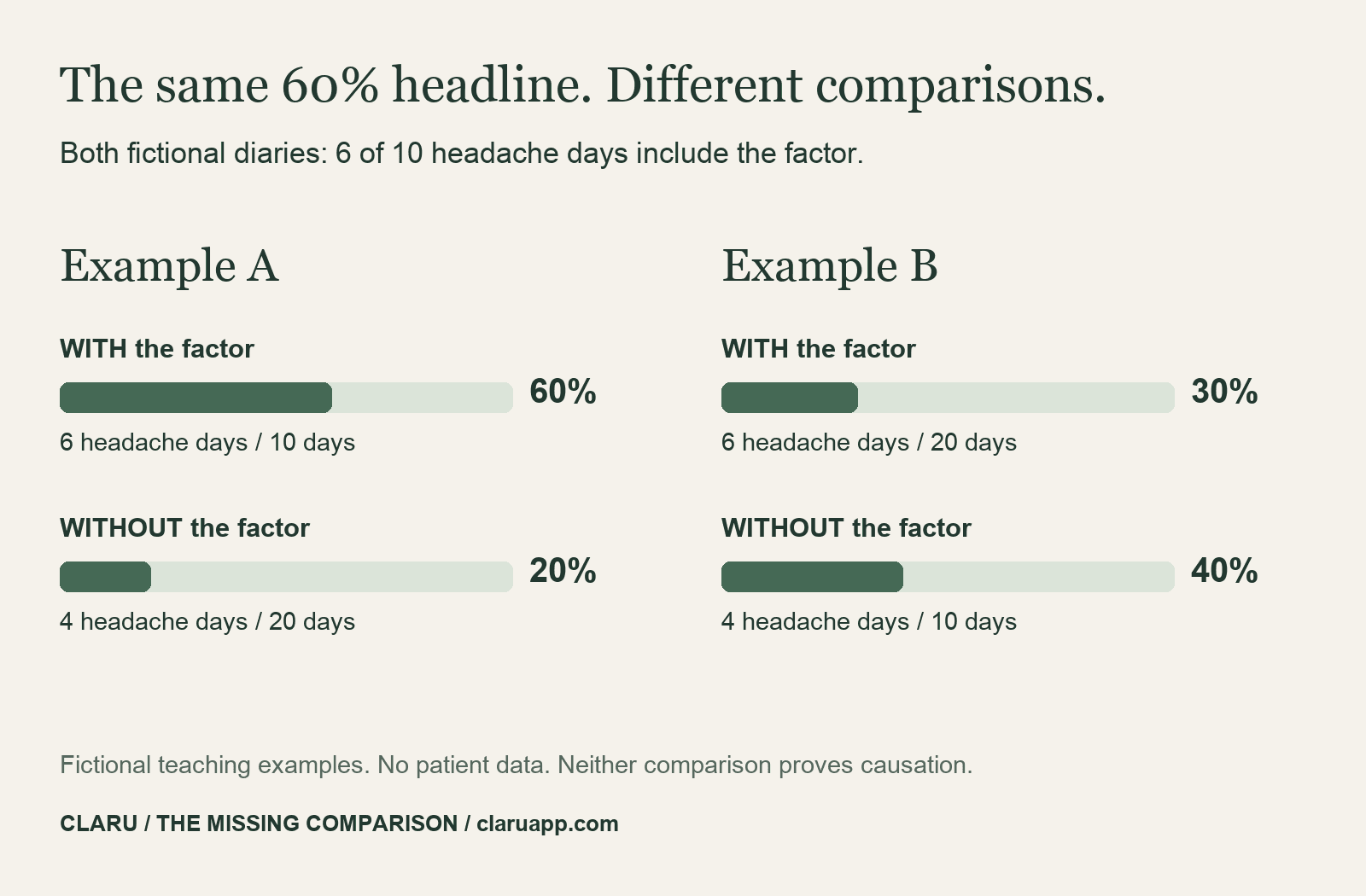
Imagine two different, fully recorded 30-day diaries. In both, there are ten headache days. In both, six of those headache days include the same suspected factor.
The headline is identical: “The factor appeared on 60% of headache days.”
Now look at all the days.
| Fictional diary | Factor recorded | Factor recorded as absent |
|---|---|---|
| Example A | 6 headache days out of 10 days: 60% | 4 headache days out of 20 days: 20% |
| Example B | 6 headache days out of 20 days: 30% | 4 headache days out of 10 days: 40% |
These are invented teaching examples, not Claru user data, clinical findings, or estimates of anyone's migraine risk. All 30 days in each example have known headache and factor status. “Headache day” is the recorded outcome, not a verified migraine diagnosis.
In Example A, headache is recorded more often on days with the factor. In Example B, it is recorded less often. Counting only what happened on headache days hid that difference.
Neither month proves that the factor caused or prevented an attack. These are small samples. Timing, chance, other changes, and the way entries were recorded could all affect the pattern. The example illustrates why the question matters, rather than supplying a test you can use to label a trigger.
Download the fictional example values (CSV). These invented values illustrate arithmetic, not patient outcomes.
What a migraine trigger diary should help you compare
For a factor you are already noticing in everyday life, aim to distinguish four situations:
- The factor was present and a headache occurred.
- The factor was present and no headache occurred.
- The factor was absent and a headache occurred.
- The factor was absent and no headache occurred.
A fifth situation needs its own place: you do not know.
Perhaps you missed a day, cannot remember the timing, or do not know whether an ingredient was in a meal. Keep that uncertainty visible. A blank entry cannot tell you whether you had no headache, no exposure, or no opportunity to log.
In the worksheet accompanying this guide, “unknown” is an explicit option. The comparison uses only days for which both the factor and headache status are known, and keeps a separate count of incomplete days. That does not remove the bias from missing information, but it avoids silently inventing an answer.
For example, if your hardest days are also the days when logging is impossible, the completed entries may understate what you experienced. Write that limitation beside the summary.
A suspected trigger may also be an early symptom
Head pain is not always the first part of an attack you notice. Food cravings, fatigue, and muscle stiffness can occur during the prodrome phase. That means an event remembered as happening “before the migraine” may have happened after the attack had already begun. American Migraine Foundation: migraine prodrome
That possibility does not make your observation wrong. It makes the order of events worth recording.
If practical, note when you first noticed a change, when the suspected factor occurred, and when head pain began. “Craving at lunchtime; ate afterward; pain in the evening” contains more information than a single food label. If you do not remember the times, approximate or mark them unknown.
Keep symptoms without headache in the record, too. “No headache” should not be read as “no symptoms” or “no impact.”
What research adds to the picture
A 2022 observational study followed 328 people using an app for 90 days. Participants endorsed an average of 28 possible triggers; an average of 2.2 per person showed a statistically significant association with increased attack risk in the study's individual analyses. Casanova and colleagues, Headache
This was a study of one selected group, with its own measurements and statistical methods. It does not establish that everyone has two triggers, that unconfirmed triggers are imaginary, or that an observed association is causal. Its practical relevance is the gap between suspecting a factor and testing an association with repeated observations.
Our fictional example above is separate from that study. It is a simple arithmetic illustration, not a reproduction of the researchers' analysis.
Keep the record manageable
The printable companion gives you one week per diary sheet and a separate comparison page. Use as many weekly sheets as you need. Choose one clearly described factor to observe, without deliberately provoking symptoms or changing your prescribed treatment.
A useful description might be “lunch later than my usual time,” with your usual time written down. “Bad day” is harder to interpret because its meaning can change from one entry to the next.
Keep the basic headache record alongside that observation: timing, severity, other symptoms, medication, and how the day was affected. The Migraine Trust recommends a simple diary and describes the kinds of details that can help with care discussions. The Migraine Trust: keeping a headache diary
When a headache diary is used in assessment, NICE recommends recording for at least eight weeks, including headache characteristics, associated symptoms, medication, possible precipitating factors, and any relationship to menstruation. Eight weeks is a recording recommendation, not a promise that a personal trigger will become clear. NICE CG150, recommendation 1.1.4
If tracking becomes exhausting, bring that up with your clinician. A smaller record you can manage may be more useful than an elaborate system you cannot sustain.
Bring a question, along with the numbers
An observation can be worth discussing without being settled. You might take this sentence to an appointment:
“I noticed this factor on several headache days. Here is how often it occurred on the other recorded days, what I could not record, and whether symptoms had already started. What would make this pattern useful to investigate?”
Also bring treatment changes, unusual routines, and a sense of how representative the recorded weeks were. See Claru's doctor appointment checklist for help organising the conversation.
A diary should never delay urgent care. Seek urgent medical help for a sudden, exceptionally severe headache or new weakness, difficulty speaking, or confusion. NHS: migraine
Make room for the days between attacks
Use the printable worksheet, a notebook, or a system that feels manageable. The useful habit is preserving the comparison and the uncertainty.
Claru offers migraine tracking for recording attacks and their context. Whichever format you choose, give days without head pain a place in the record, and use patterns as questions to explore with a qualified clinician.
About this resource: Created by Claru, a commercial migraine-tracking app. Educational material; not a diagnostic instrument or a validated trigger test. No individual patient records are used. The arithmetic example and worksheet are original Claru educational materials. This article has not been independently medically reviewed.