Does Weather Affect Migraines? What Research Says
By the Claru Editorial Team
This educational article has not been independently medically reviewed. It cannot diagnose a condition or replace care from a qualified healthcare professional. Read our editorial standards.

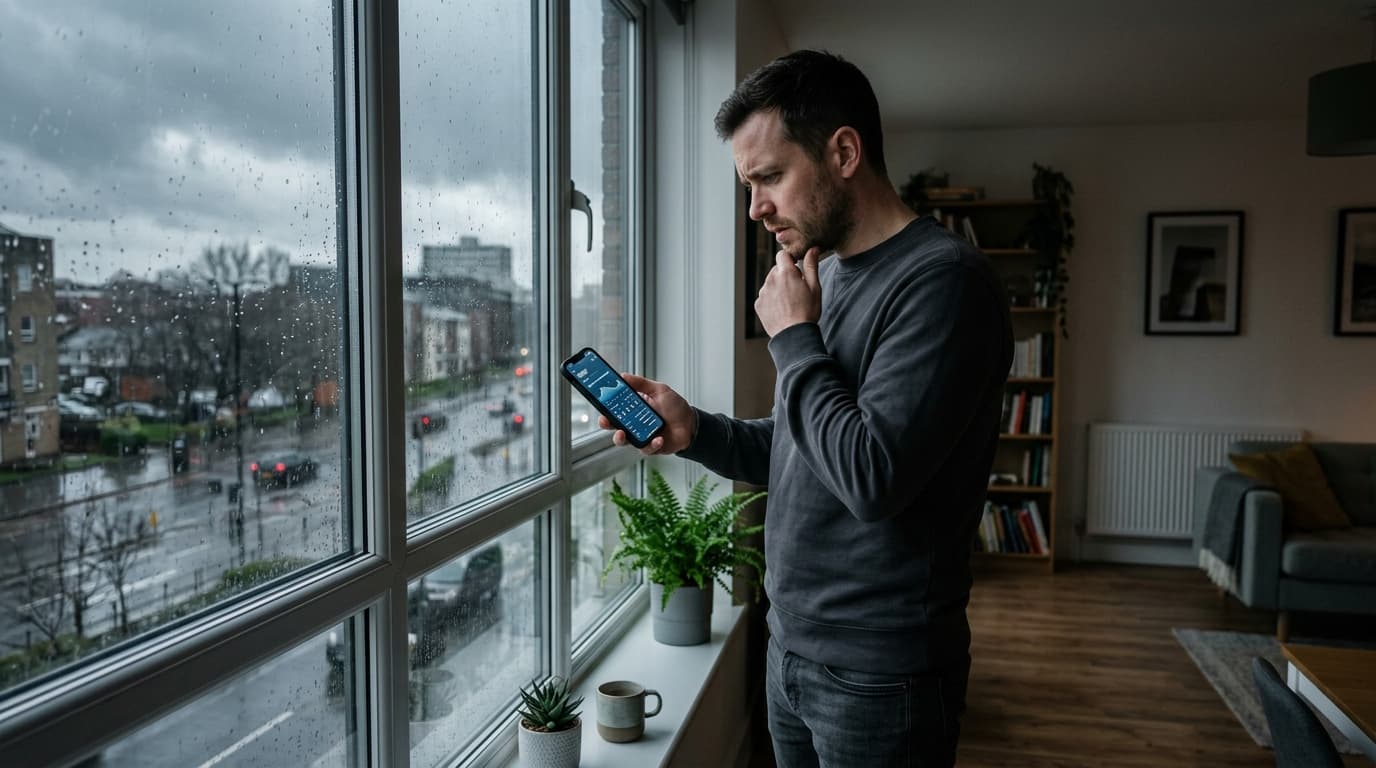
Weather can affect migraines for some people, but the link is individual and usually modest. The best-studied patterns are falling barometric pressure and hotter temperatures. In one diary study, attacks became more frequent when pressure dropped by more than 5 hPa, and a large emergency department study found headache visits rose about 7.5% for every 5°C of warmer weather. Other studies find no clear effect, so the useful question is whether weather affects your migraines.
If you've ever said "I can feel a storm coming in my head," you're not imagining things. Many people with migraine name weather as a trigger. This guide explains what the research does and does not show, and how to test your own pattern.
This guide covers temperature, humidity, and air quality alongside pressure. For the full pressure explanation, see our main barometric pressure headache guide, or try the free migraine weather forecast tool.
The Barometric Pressure Link
Barometric pressure is the weight of the atmosphere pressing down on us. When a weather front moves through, this pressure can drop or rise quickly. In a year-long diary study from Dokkyo Medical University in Japan, migraine attacks became more frequent when pressure fell by more than 5 hPa from one day to the next.
Why? The mechanism is not proven. One theory is that pressure changes act on the inner ear, which has connections to the trigeminal nerve, the main nerve involved in migraine pain. Another is that weather changes several things at once, such as sleep, hydration and light exposure, and those add up.
What the studies found
- Kimoto et al., Internal Medicine (2011): 28 people with migraine kept a diary for a year. Weather changes were associated with attacks in 18 of 28 (64%), and 14 of them named low pressure. The sample was small.
- Mukamal et al., Neurology (2009): 7,054 emergency visits for headache in Boston. Lower pressure in the 48 to 72 hours before raised risk modestly, and mainly for headaches that were not migraine.
- Results across studies are mixed, which fits the idea that only some people are weather-sensitive.
Temperature Changes
Heat has the clearest signal in large data sets. The 2009 Neurology study above found that every 5°C (9°F) of higher temperature in the previous 24 hours raised the risk of a headache emergency visit by about 7.5%, for migraine and non-migraine headaches alike.
Hot weather is particularly problematic because it can lead to:
- Dehydration (itself a major trigger)
- Poor sleep quality
- Increased light exposure and glare
- Changes in routine (eating, drinking, exercise patterns)
Humidity and Air Quality
High humidity makes it harder for your body to regulate temperature and can contribute to dehydration. Low humidity dries out mucous membranes and can irritate sinuses.
Air quality is less clear than many articles suggest. The same Boston study found no clear association between pollutant levels (fine particles, black carbon, nitrogen and sulfur dioxides) and headache visits, although the authors could not rule out smaller effects. Many people still report smoke or strong odours as personal triggers, which is why it is worth logging air quality alongside your attacks rather than assuming either way.
What You Can Do
Track the correlation
The first step is confirming whether weather actually affects your migraines. Many people assume it does but haven't verified the pattern. This is where consistent logging matters.
With Claru Pro, weather data (barometric pressure, temperature, humidity and air quality) is matched to your migraine logs automatically. Over time, the app shows whether pressure drops or other weather patterns line up with your attacks and how strong that link is. You can log an attack by voice in a few seconds, and the 7-day risk forecast is included without Pro.
See the Claru migraine tracking app for a practical way to keep those observations in one history.
For the wider context, visit the migraine triggers hub to compare weather with stress, sleep, meals, hormones, and other possible influences.
Prepare, don't despair
You can't change the weather, but you can prepare for it:
- Check the forecast — Claru's risk prediction factors in upcoming weather patterns
- Take preventive medication — if your doctor has prescribed it, weather-triggered migraines may respond to early intervention
- Stay hydrated — especially during hot, humid days or before storms
- Maintain your routine — weather changes often disrupt sleep and eating patterns, compounding the effect
Know your threshold
Not every pressure drop affects every person the same way, and there is no proven universal threshold. The 5 hPa figure from the Japanese study is a useful starting point for your own log. Tracking over several months helps you see whether you react at all, and to which kind of change. For a pressure-focused deep dive, see the barometric pressure headache guide, and if you are unsure whether your headaches are migraine at all, start with migraine vs. headache.
Sources: Kimoto K. et al. (2011), "Influence of barometric pressure in patients with migraine headache," Internal Medicine 50(18), doi:10.2169/internalmedicine.50.5640; Mukamal K.J. et al. (2009), "Weather and air pollution as triggers of severe headaches," Neurology 72(10), PMC2677474; Prince P.B. et al. (2004), "The effect of weather on headache," Headache 44(6); NHS: Migraine. This article has not been medically reviewed.
Frequently asked questions
- Does weather affect migraines?
- For some people, yes, but not for everyone and usually not on its own. In a Japanese diary study, weather changes were linked to attacks in 18 of 28 people with migraine, mostly when pressure fell. A large US study found headache emergency visits rose about 7.5% for every 5°C of warmer temperature. Other studies find no clear link, so the only way to know is to compare your own attacks with weather data.
- How does weather trigger a migraine?
- The mechanism is not proven. Leading ideas are that pressure changes act on the inner ear and the trigeminal nerve, and that heat adds strain through dehydration, poor sleep and glare. Weather often changes several factors at once, which is why it tends to work as one trigger among others rather than a single cause.
- What kind of weather causes migraines?
- The patterns most often studied are falling barometric pressure before a storm, rapid swings in pressure, hot days and high humidity. Some people also report bright sunlight, strong wind or smoke. Which ones matter differs from person to person.
- Can air pollution trigger migraines?
- The evidence is mixed. The large Boston emergency department study by Mukamal and colleagues found no clear association between same-day pollutant levels and headache, although the authors could not rule out smaller effects. Smoke and strong odours are still reported as personal triggers by many people.
- How do I know if weather triggers my migraines?
- Keep a headache diary for at least two to three months and record pressure, temperature and humidity for each day, including headache-free days. If attacks happen clearly more often after a certain pattern, such as a pressure drop of 5 hPa or more, that is a lead worth discussing with your doctor.