Headache Behind Right Eye: 7 Causes and When to Worry

That sharp, insistent pain behind your right eye — it's hard to think about anything else when it's there. You press your fingers against your eye socket, wondering if something is seriously wrong.
Here's the reassuring part first: most headaches behind the eye have treatable, non-dangerous causes. But the specific cause matters, because the treatment for each one is different. An eye strain headache responds to rest. A cluster headache needs specific medication. A sinus headache needs decongestants.
If your pain is on the other side, read the companion guide to headache behind the left eye.
Let's figure out which one you're dealing with.
1. Migraine
Migraine is the most common cause of recurring, severe pain behind one eye. It tends to favor one side of the head — and for many people, that means the pain concentrates behind or around one eye.
How to recognize it:
- Throbbing or pulsating pain, usually moderate to severe
- Pain gets worse with physical activity (walking, climbing stairs, bending over)
- Sensitivity to light and sound — you want to be in a dark, quiet room
- Nausea, sometimes vomiting
- May be preceded by visual aura (flashing lights, zigzag lines)
- Lasts 4-72 hours if untreated
Why it hits behind the eye: The trigeminal nerve — the main nerve responsible for face and head pain — has a branch (V1, the ophthalmic branch) that runs directly through the eye socket. When a migraine activates the trigeminal system, this branch lights up, producing deep pain behind and around the eye.
What helps: Triptans or NSAIDs taken early, dark room, cold compress, pressure point techniques. For frequent migraines (4+ per month), talk to your doctor about preventive medication.
2. Cluster Headache
If the pain behind your right eye is the worst pain you've ever felt — sharp, burning, like a hot poker being driven through your eye socket — it might be a cluster headache. These are relatively rare (affecting about 0.1% of the population) but are often called "suicide headaches" because of their severity.
How to recognize it:
- Excruciating, piercing pain centered on or behind one eye
- Always on the same side (right or left, doesn't switch)
- Attacks last 15 minutes to 3 hours
- Eye on the affected side gets red, teary, or droopy
- Nostril on the affected side gets congested or runny
- You feel restless — pacing, rocking, unable to sit still
- Attacks come in "clusters" — daily for weeks or months, then disappear
The timing pattern is the giveaway. Cluster headaches often strike at the same time each day, frequently waking people from sleep 1-2 hours after falling asleep. They tend to occur in seasonal clusters (spring and fall are common) and then go into remission for months or years.
What helps: Cluster headaches require specific treatment — regular painkillers barely touch them. High-flow oxygen (100% oxygen via mask at 12-15 liters/minute) is the gold standard for aborting an attack. Sumatriptan injection works fast too. For prevention during a cluster period, verapamil is commonly prescribed. See a neurologist if you suspect cluster headaches — they need a proper diagnosis and treatment plan.

3. Eye Strain (Digital Eye Strain)
If you spend hours staring at screens — and who doesn't — eye strain is a very common cause of headaches behind the eyes. The technical term is "asthenopia," and it affects roughly 50% of regular computer users according to the American Academy of Ophthalmology.
How to recognize it:
- Dull, aching pain behind both eyes (or one eye if you have unequal vision)
- Pain worsens as the day goes on, especially after screen time
- Eyes feel tired, dry, or gritty
- Difficulty focusing, especially shifting between near and far objects
- Mild headache that resolves when you stop the visual task
- No nausea, no light sensitivity, no severe throbbing
What helps:
- The 20-20-20 rule: Every 20 minutes, look at something 20 feet away for 20 seconds
- Adjust screen brightness to match your environment
- Position your monitor at arm's length, slightly below eye level
- Use artificial tears if your eyes feel dry
- Get your vision checked — uncorrected or undercorrected prescriptions are a major cause
- Consider blue-light-filtering glasses (the evidence is mixed, but some people find them helpful)
4. Sinus Headache
When the sinuses behind your eyes and forehead get inflamed — from a cold, allergies, or infection — they produce a headache that's easy to confuse with migraine. The pain is concentrated around the forehead, cheeks, and behind the eyes.
How to recognize it:
- Deep, constant pressure (not throbbing) behind the eyes and across the forehead
- Pain worsens when bending forward or lying down
- Nasal congestion or discharge (often thick, green, or yellow with infection)
- Reduced sense of smell
- Possible low-grade fever with sinus infection
- Pain may be worse in the morning (mucus accumulated overnight)
Important: Research from the American Migraine Foundation found that up to 90% of self-diagnosed "sinus headaches" are actually migraines. If you have recurring "sinus headaches" without actual congestion or infection, you probably have migraines. Getting the right diagnosis changes the treatment completely.
What helps: For actual sinus headaches: nasal saline rinse, steam inhalation, decongestants (short-term only), and antihistamines for allergies. If you have signs of bacterial infection (thick colored discharge, fever, pain for 10+ days), see your doctor for possible antibiotics.
5. Tension Headache
Tension headaches are the most common type of headache overall, and while they usually feel like a band around the whole head, they can also concentrate behind one eye — especially if you carry tension in the muscles around your eyes and forehead.
How to recognize it:
- Mild to moderate pressing or tightening pain (not throbbing)
- Feels like a band or vice around your head, sometimes focused behind one eye
- No nausea, no light sensitivity (or only very mild)
- Can last 30 minutes to several days
- Often related to stress, poor posture, or jaw clenching
What helps: OTC pain relief (ibuprofen, acetaminophen), stress management, improved posture, neck and shoulder release exercises, massage, and taking breaks from repetitive tasks. If you're getting tension headaches more than twice a week, it's time to see a doctor.
6. Cervicogenic Headache (Neck-Related)
This one surprises people. A problem in your neck — a stiff joint, tight muscles, a disc issue — can refer pain directly to the area behind your eye. The nerve pathways from the upper neck converge with the trigeminal nerve in the brainstem, so your brain interprets neck problems as eye pain.
How to recognize it:
- Pain usually starts in the neck or base of skull and radiates forward to behind the eye
- Pain is on one side and stays on that side
- Neck stiffness or reduced range of motion
- Pain triggered or worsened by certain neck positions or movements
- Pressing on specific neck muscles reproduces the eye pain
What helps: Physical therapy is the most effective treatment — specifically manual therapy and exercises targeting the upper cervical spine. If you have a desk job, ergonomic adjustments can prevent recurrence. Some people benefit from trigger point injections.
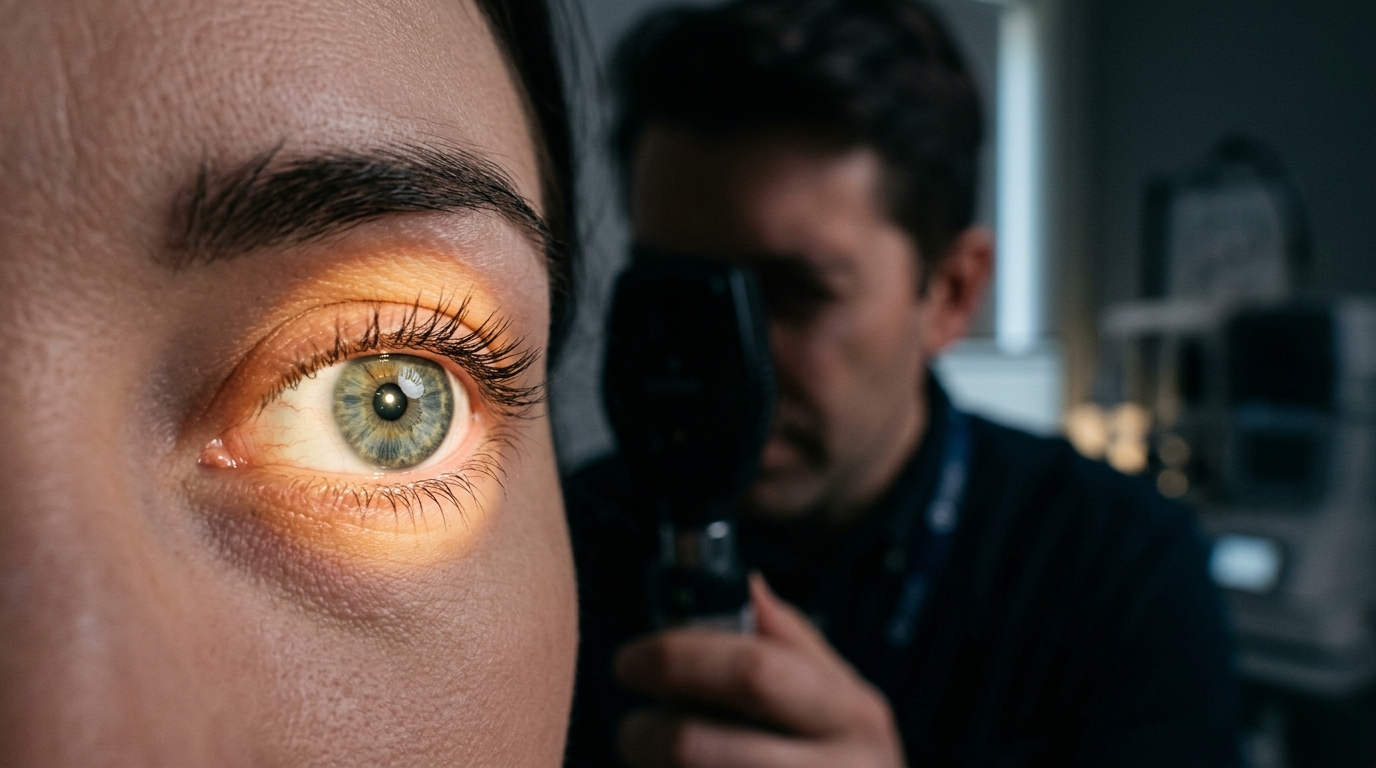
7. Optic Neuritis (Less Common but Important)
Optic neuritis is inflammation of the optic nerve — the nerve that carries visual information from your eye to your brain. It causes pain behind the eye that worsens with eye movement.
How to recognize it:
- Pain behind one eye, especially when moving the eye
- Vision loss or blurring in the affected eye (usually develops over hours to days)
- Colors appearing washed out or dimmer in one eye
- A blind spot, especially in central vision
Why it matters: Optic neuritis can be an early sign of multiple sclerosis (MS) — roughly 50% of people with MS have optic neuritis at some point, and for about 15-20% it's their first symptom. It can also occur on its own or with other autoimmune conditions.
What to do: See an eye doctor or neurologist promptly. Diagnosis involves an eye exam, visual field testing, and usually an MRI. Most cases recover on their own, but steroid treatment can speed recovery.
How to Tell Them Apart: The Quick Comparison
| Cause | Pain Type | Duration | Key Distinguishing Feature | |---|---|---|---| | Migraine | Throbbing, severe | 4-72 hours | Nausea, light sensitivity, worsens with activity | | Cluster headache | Piercing, extreme | 15 min–3 hours | Eye tearing/redness, restlessness, clockwork timing | | Eye strain | Dull, aching | Hours (while working) | Resolves when you stop the visual task | | Sinus headache | Deep pressure | Days | Congestion, worse bending forward | | Tension headache | Pressing, band-like | 30 min–days | Mild-moderate, no nausea | | Cervicogenic | Radiates from neck | Variable | Neck stiffness, triggered by neck movement | | Optic neuritis | Ache behind eye | Days–weeks | Pain with eye movement, vision changes |
When Pain Behind Your Eye Is an Emergency
Most causes of headache behind the eye are manageable. But go to the ER if you experience:
- Sudden, severe pain ("worst headache of my life") — possible aneurysm
- Vision loss that comes on suddenly — possible stroke or retinal emergency
- Pain with fever, stiff neck, and confusion — possible meningitis
- Eye pain after head trauma — possible orbital fracture or bleeding
- Bulging eye or inability to move the eye — possible orbital cellulitis or mass
Track the Pattern to Find Your Cause
If you're getting recurring headaches behind your right eye and you're not sure which type it is, tracking is the fastest way to an answer. Pay attention to:
- Time of day the pain starts
- How long it lasts
- What makes it better or worse
- Associated symptoms (nausea? teary eye? congestion? neck stiffness?)
- What you were doing before it started
Two to three weeks of consistent logging usually makes the pattern obvious — both to you and to your doctor.
Claru helps you track these details quickly and find the correlations. Instead of trying to remember your headache history at a doctor's appointment, you'll have data that points toward the right diagnosis.
Start tracking your headaches with Claru — it's free
Sources: American Academy of Ophthalmology, Mayo Clinic, Cleveland Clinic, American Migraine Foundation, NHS.