Pressure Points for Headaches: 10 Points That Relieve Pain Fast
Your head is pounding, you don't have medication on hand, and you need relief now. Your hands might be the best tool you've got.
Acupressure — pressing specific points on your body to relieve pain — sounds like it belongs in an alternative medicine brochure. But the research is more solid than most people expect. A study in the American Journal of Chinese Medicine found that acupressure reduced chronic headache severity by over 40% in participants who used it consistently. And a trial from Memorial Sloan Kettering Cancer Center includes acupressure in their recommended pain management protocols.
The catch? Most pressure point guides give you vague instructions like "press here and hold." That's not enough. The location needs to be precise, the pressure needs to be right, and different points work for different headache types.
Here are 10 pressure points for headaches that actually have evidence behind them — with exact techniques for each. Want the short version? Try our interactive pressure points guide with the top 7 points.
How Acupressure Works for Headaches
Before we get to the points, a quick primer on why pressing your skin can affect your head.
Acupressure works through several mechanisms. Firm pressure stimulates nerve endings that send signals to your brain, triggering the release of endorphins — your body's natural painkillers. It also increases blood flow to the pressed area and the connected tissue, and it can interrupt pain signal transmission through the gate control theory of pain (basically, the pressure signal "drowns out" the pain signal).
You don't need to believe in meridians or qi to benefit from this. The neurological mechanisms are well-documented.
General technique rules for all points:
- Press firmly but not painfully — you should feel deep pressure, not sharp pain
- Hold each point for 30 seconds to 2 minutes unless otherwise noted
- Breathe slowly and deeply while pressing
- If a point feels tender, that's usually a sign it's the right spot
- Repeat 2-3 times if the first round provides partial relief
Points on Your Hands
1. Union Valley (LI-4) — The Master Headache Point
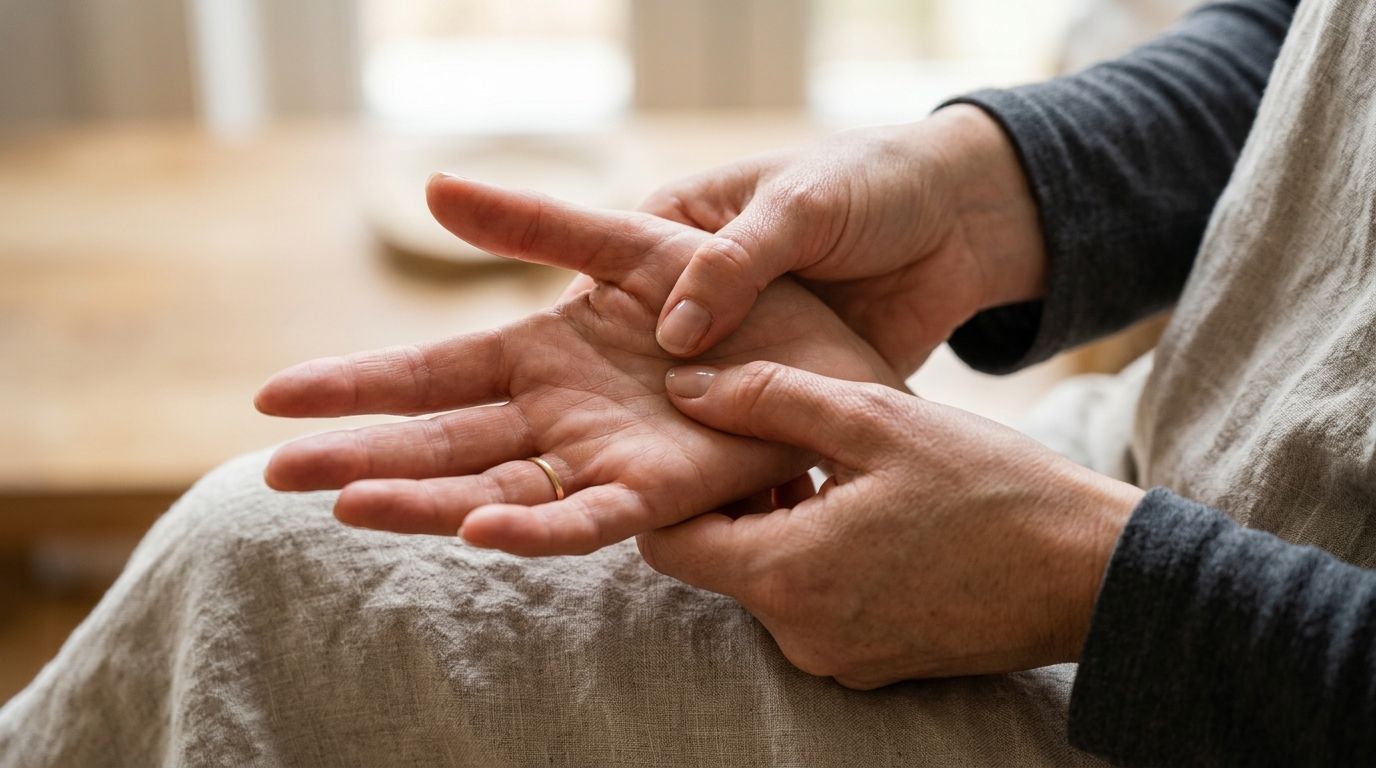
Location: The fleshy mound of muscle between your thumb and index finger. Find the highest point of the muscle when you squeeze your thumb against your finger.
Best for: Tension headaches, frontal headaches, general headache pain. This is the single most-studied pressure point for headaches.
Technique:
- Pinch the spot with your opposite thumb on top and index finger underneath
- Press your thumb firmly into the muscle, angling slightly toward the index finger bone
- Hold for 2 minutes with steady pressure
- You should feel a deep ache — that's normal
- Repeat on the other hand
What the research says: Multiple studies have shown LI-4 stimulation reduces headache intensity. It's thought to work by modulating pain pathways in the trigeminal nerve, which is responsible for most head and face pain.
Important: Avoid this point during pregnancy — it can stimulate uterine contractions.
2. Zhong Zhu (TE-3)
Location: On the back of your hand, in the groove between the knuckles of your ring finger and pinky finger. Slide about one inch down from the knuckles toward your wrist.
Best for: Tension headaches, headaches behind the eyes, temple headaches.
Technique:
- Press firmly into the groove with your opposite thumb
- Apply steady pressure for 1-2 minutes
- You may feel a dull ache radiating up your arm — that's the point activating
- Switch hands and repeat
This point is often overlooked in headache guides, but it's effective for headaches concentrated around the temples and behind the eyes.
Points on Your Head and Face
3. Third Eye Point (GV-24.5)
Location: The indentation right between your eyebrows, where the bridge of your nose meets your forehead.
Best for: Frontal headaches, eye strain headaches, sinus pressure.
Technique:
- Place your index or middle finger on the point
- Press firmly and slightly upward
- Hold for 60 seconds
- Close your eyes while pressing — this enhances the effect
- Release slowly, then repeat 2 more times
This point helps relieve tension in the forehead, sinuses, and the muscles around the eyes. It's especially useful if you've been staring at screens all day and have that dull frontal pressure building.
4. Drilling Bamboo (UB-2)
Location: The inner edge of each eyebrow, right where the brow meets the bridge of your nose. Feel for the small notch or indentation in the bone.
Best for: Sinus headaches, frontal headaches, eye fatigue headaches.
Technique:
- Place both index fingers on the inner corners of your eyebrows
- Press firmly upward into the bony ridge
- Hold for 10 seconds, release for 5 seconds
- Repeat 5-6 times
- On the last press, hold for 30 seconds
Works particularly well for sinus-related headache pressure. If your headache is focused behind or above your eyes, start here.
5. Welcome Fragrance (LI-20)
Location: On either side of your nostrils, in the crease where your nose meets your cheek.
Best for: Sinus headaches, congestion headaches, facial pressure.
Technique:
- Place both index fingers beside your nostrils
- Press inward and slightly upward
- Hold for 1-2 minutes
- Breathe deeply through your nose while pressing — you may notice your airways open
This point directly targets sinus congestion and is especially useful during allergy season or when a cold is triggering headaches.
6. Temples (Taiyang)
Location: In the soft depression about one finger-width behind the midpoint between the outer edge of your eyebrow and the outer corner of your eye.
Best for: Migraine, temporal headaches, stress headaches.
Technique:
- Place your fingertips on both temples simultaneously
- Apply firm, steady pressure
- Slowly massage in small circles — 10 rotations clockwise, then 10 counterclockwise
- Continue for 2-3 minutes
Most people instinctively rub their temples when they have a headache, and there's a good reason for it. This area sits directly over the temporalis muscle, which tenses up during both migraines and tension headaches.

Points on Your Neck and Shoulders
7. Gates of Consciousness (GB-20)
Location: At the base of your skull, in the two hollows on either side of your spine where the neck muscles attach. If you slide your fingers up the back of your neck, you'll feel two distinct dips right where the skull begins.
Best for: Tension headaches, neck-related headaches, migraine, headaches that start at the back of the head.
Technique:
- Place your thumbs on both points with your fingers wrapped around the back of your head
- Press firmly upward and slightly inward, toward the center of your head
- Tilt your head back slightly to increase the pressure
- Hold for 30 seconds, release, repeat 4-5 times
- After the last press, slowly rotate your head side to side while maintaining light pressure
This is one of the most powerful headache pressure points. The suboccipital muscles that attach here are responsible for a huge percentage of tension headaches. If your headache started in your neck and crept up over your skull, GB-20 should be your first stop.
8. Shoulder Well (GB-21)
Location: On the top of your shoulder, roughly halfway between your neck and the edge of your shoulder. Feel for the tightest, most tender spot in the trapezius muscle.
Best for: Tension headaches, stress headaches, headaches with neck and shoulder stiffness.
Technique:
- Use your opposite hand to pinch the muscle between your thumb and fingers
- Press your thumb firmly into the tightest spot
- Hold for 1-2 minutes
- You can also press down on this point with your fingertips while slowly rolling your shoulder
- Repeat on both sides
If you carry stress in your shoulders (and who doesn't?), this point will likely feel intensely tender. That tenderness is a sign that tension here is contributing to your headaches.
Note: Like LI-4, avoid heavy pressure on this point during pregnancy.
9. Heaven's Pillar (BL-10)
Location: About one finger-width below the base of the skull, on the thick muscle cords on either side of the spine. These are the muscles that feel like ropes running up the back of your neck.
Best for: Tension headaches, stiff neck headaches, stress-related headaches, headaches at the back of the head.
Technique:
- Place your fingertips on both points
- Press firmly inward (toward your spine) and slightly upward
- Hold for 1-2 minutes
- While holding pressure, slowly nod your head forward and back in small movements
This point works well in combination with GB-20 (Gates of Consciousness). Press GB-20 first for 30 seconds, then move down to BL-10 for another 30 seconds. The combination releases tension along the entire posterior neck.
Points on Your Feet
10. Bigger Rushing (LV-3)
Location: On the top of your foot, in the webbing between your big toe and second toe. Slide your finger back from the web about two finger-widths toward your ankle — you'll feel a bony groove.
Best for: Migraine, stress headaches, headaches with irritability or anger.
Technique:
- Press your thumb firmly into the groove
- Angle the pressure slightly toward the big toe bone
- Hold for 2 minutes per foot
- You should feel a deep, spreading ache
This point might seem odd for headaches — it's on your foot, after all. But LV-3 is one of the most commonly used points in acupuncture for migraine specifically. It's thought to help regulate the flow of energy upward through the body. Whether you buy that explanation or not, clinical trials show consistent results for headache relief.
The 5-Minute Headache Relief Sequence
Don't have time to work through all 10 points? Here's a focused sequence using the four most effective pressure points. Do this in order:
Step 1 (1 minute): LI-4 (Union Valley) — Both hands, 30 seconds each
Step 2 (1 minute): GB-20 (Gates of Consciousness) — Both sides simultaneously, hold 1 minute
Step 3 (1 minute): Third Eye Point — Single point, hold 1 minute with eyes closed
Step 4 (2 minutes): Temples — Circular massage, 1 minute each direction
This sequence covers the major pain pathways for most headache types and can be done at your desk, on the train, or anywhere you've got your hands free.
Which Points Work for Which Headaches?
| Pressure Point | Tension | Migraine | Sinus | Eye Strain | |---|---|---|---|---| | LI-4 (Union Valley) | Best | Yes | No | Yes | | TE-3 (Zhong Zhu) | Yes | No | No | Best | | Third Eye (GV-24.5) | Yes | No | Yes | Best | | Drilling Bamboo (UB-2) | No | No | Best | Yes | | Welcome Fragrance (LI-20) | No | No | Best | No | | Temples (Taiyang) | Yes | Best | No | Yes | | GB-20 (Gates of Consciousness) | Best | Yes | No | No | | GB-21 (Shoulder Well) | Best | No | No | No | | BL-10 (Heaven's Pillar) | Best | No | No | No | | LV-3 (Bigger Rushing) | No | Best | No | No |
Making Acupressure Work Better
A few things that enhance the effect:
Combine with breathing. Slow, deep breaths while pressing a point amplify the parasympathetic response. Try the 4-7-8 breathing technique while working through your points.
Consistency beats intensity. Moderate, sustained pressure for 2 minutes outperforms intense pressure for 30 seconds. Don't bruise yourself trying to push harder.
Use it preventively, not just reactively. If you get tension headaches every afternoon, spend 5 minutes on the sequence during your lunch break — before the headache starts.
Track what works for you. Not every point works for every person. The first few times you try acupressure, note which points provided relief and which didn't. After a couple of weeks, you'll know your personal top 3-4 points and can skip the rest.
We built an interactive pressure points guide that lets you explore the top 7 points and mark which ones work for you — try it out.
Tracking your headache relief methods — including which pressure points helped and which didn't — is one of the most useful things you can log in Claru. Over time, you'll build a clear picture of what actually works for your specific headaches.
Start tracking your headache patterns and relief methods with Claru
When Acupressure Isn't Enough
Pressure points are a tool, not a cure-all. They're great for:
- Mild to moderate headaches
- Situations where you can't take medication
- Supplementing other relief methods
- Preventive daily practice
But if you're dealing with severe migraines, daily headaches, or headaches that don't respond to any self-care measures, that's a sign something bigger is going on. Talk to your doctor — and bring your tracking data. The combination of what triggers your headaches and what relieves them gives a doctor exactly what they need to build an effective treatment plan.
Not sure what type of headache you're dealing with? Our guide on early migraine warning signs can help you identify whether your headaches are migraines.
Sources: American Journal of Chinese Medicine, Memorial Sloan Kettering Cancer Center, National Headache Institute, Healthline, University of Minnesota Center for Spirituality & Healing.